
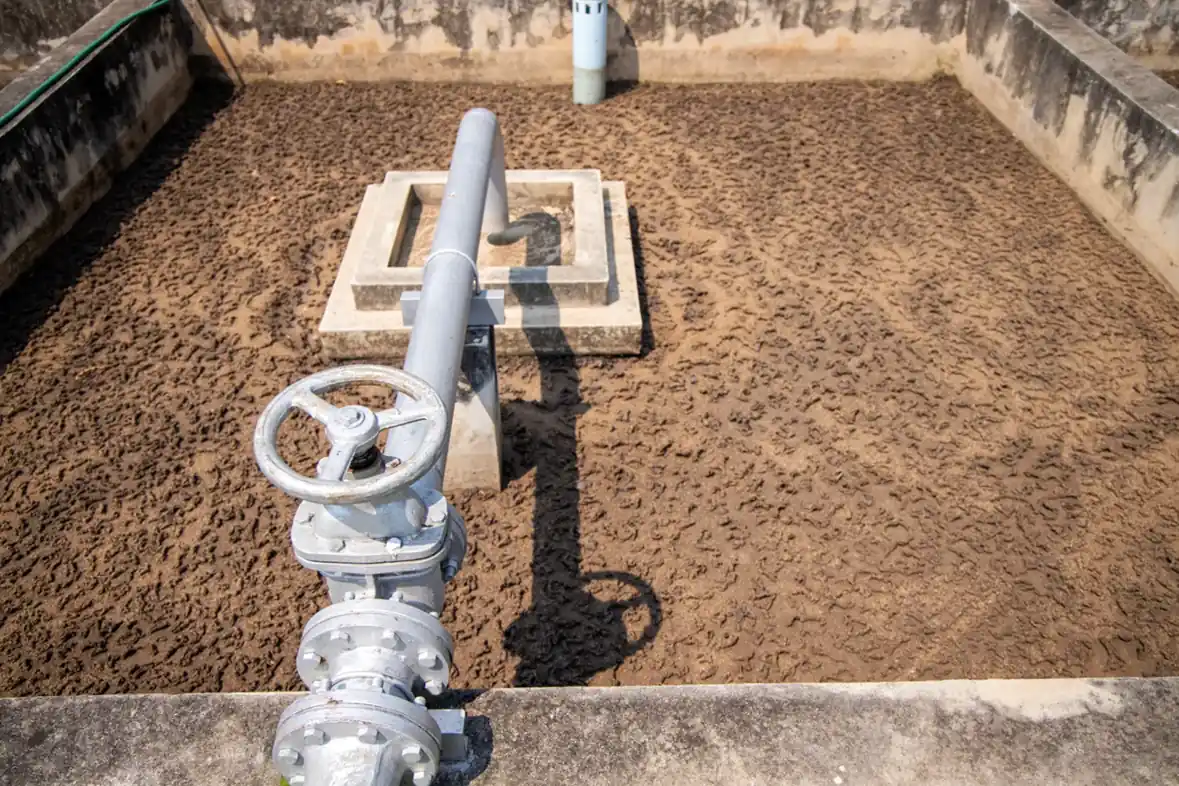
Industrial sludge removal
Sludge Disposal
Sludge disposal is rarely a single decision. The route depends on what the sludge contains, how wet it is, where it is produced and which nation's rules apply. This page sets out the main recovery and disposal options and the questions that shape them.
What sludge disposal involves
Sludge is the settled or suspended solids that accumulate in tanks, lagoons, interceptors, digesters and process systems. Disposal is the end of a chain that usually starts with removing it from where it sits, reducing its water content, and establishing what it actually is. Get the order wrong and costs rise or loads get rejected.
Three things drive the route: the origin of the sludge, its contaminant profile, and its physical form. Sewage sludge from a municipal works behaves differently from oily tank bottoms, paint booth sludge or drilling mud. We can help with sludge disposal projects where the material needs to leave site under the correct documentation and reach a facility that can lawfully take it.
Classification comes before routing
You cannot choose a disposal route from a name alone. A sludge described as ‘oily’ is not automatically hazardous, and a sludge that looks inert is not automatically non-hazardous. Classification follows the Environment Agency’s technical guidance WM3 in England, with equivalent approaches in Wales, Scotland and Northern Ireland. It considers the substances present, their concentrations and the physical form.
Where the origin is known and consistent, an assessment based on process knowledge may be enough. Where the source is mixed or unknown, sampling and laboratory analysis give a defensible position. The output is a List of Waste code, often called an EWC code, plus a hazardous or non-hazardous determination. Our sludge waste classification page covers that process in more detail.
Documentation supports traceability. A waste transfer note or, for hazardous waste, a consignment note records what moved, when and between whom. In Scotland the term special waste is used. These records do not by themselves prove that a route was correct.
Anaerobic digestion and biological treatment
Anaerobic digestion treats organic sludge in the absence of oxygen, producing biogas and a digested residue. It suits sewage sludge and many food or agricultural sludges with a high organic fraction. The digester reduces volatile solids and can improve dewaterability, but it does not remove heavy metals or persistent organic contaminants. Those stay in the digestate and influence where it can go next.
Aerobic treatment and composting play a similar role for some sludges. Both need a consistent feed. A load with high grit, plastics or solvent content can upset a biological process, so pre-treatment and screening matter.
Landspreading and agricultural recovery
Spreading treated sludge to agricultural land is a recovery route, not a disposal shortcut. In England, sewage sludge may be spread under the Sludge (Use in Agriculture) Regulations where their conditions are met, while permitted landspreading routes include SR2010 No 6 for sewage sludge and other permits for specified wastes and activities. SR2010 No 4 covers listed wastes for landspreading but is not the general permit for ordinary sewage sludge. The applicable route must be checked for the specific material and activity.
Not every sludge qualifies. Nutrient value, contaminant concentrations, soil pH, crop type and proximity to water all affect whether spreading is acceptable. A sludge to land assessment should establish that the material benefits the soil rather than simply being tipped on it. Records of applications, analyses and field conditions are part of the duty of care.
Incineration and thermal treatment
Incineration destroys organic material and reduces volume, which suits sludges that cannot be recycled or spread. Energy recovery is possible where the calorific value justifies it. The trade-off is cost and the need for a facility permitted to take that specific waste. Ash from incineration still requires disposal or recovery, and its classification depends on what was burned.
Other thermal routes, including pyrolysis and gasification, exist for particular sludges. They are not universal substitutes for incineration and depend on consistent feedstock.
Physico-chemical treatment
Physico-chemical treatment uses chemical reactions, separation or stabilisation to change a sludge so it can be handled or sent elsewhere. Common examples include neutralisation of acidic sludges, precipitation of metals, and oil and water separation. The output is usually a treated solid or liquid plus a residue that still needs a route.
This option is often used where a sludge is too contaminated for biological treatment but too dilute for direct incineration. It can reduce hazard characteristics, but it does not make the resulting waste automatically non-hazardous. The treated material needs its own classification.
Landfill and the liquid waste ban
Landfill is the least preferred route and is restricted. The landfilling of liquid waste is banned in England, Wales and Scotland, with equivalent controls in Northern Ireland. The ban applies to waste that is liquid at the point of deposit, and there are tests and criteria used to judge that. Sludge is excluded from the definition of liquid waste in the relevant guidance, which means a sludge can be landfilled if it meets the other conditions.
Those conditions include pre-treatment to reduce volume or hazard, and waste acceptance criteria, usually called WAC. WAC testing establishes whether a waste can go to a particular landfill class, such as inert, non-hazardous or hazardous. WAC does not replace classification. A waste still needs its EWC code and hazardous or non-hazardous determination before WAC is relevant.
Dewatering is often the step that makes landfill viable. Removing water reduces volume, lowers transport weight and can help the material meet the physical requirements of the site. Our sludge dewatering page explains the methods and their limits.
Why dewatering usually comes first
Most sludges arrive with a high water content. Water is the part that costs money to move and treat without contributing to the recovered material. Thickening, mechanical dewatering, drying beds and filter presses all reduce that fraction. The choice depends on the sludge type, the target dry solids content and what the receiving facility will accept.
Dewatering changes the water content and handling characteristics, but it does not by itself make hazardous material non-hazardous. Treatment can affect the waste code or description in some cases, so the dewatered material should be checked against the applicable classification guidance. A liquid stream separated during dewatering may itself need a treatment or disposal route, so both outputs need to be considered.
Treatment technologies in brief
Thickening raises dry solids before further treatment, using gravity, dissolved air or mechanical methods. Digestion stabilises organic matter. Lime stabilisation raises pH and reduces pathogens, which can make sludge suitable for certain land applications, though it adds mass. Thermal drying produces a drier product with different handling needs.
In England, the Environment Agency’s RPS 231 allows specified additional waste codes for certain treated sewage and septic tank sludges where its conditions and the relevant exemption or standard rules permit are met. It is not a general classification rule for all sludges.
Hazardous sludge and national differences
Hazardous sludge requires a consignment note system and movement through authorised carriers and consignees. In Scotland, special waste rules apply. Northern Ireland and Wales have their own regulator guidance. If your site operates across borders, the paperwork and the receiving facility’s permit both need checking against the nation where the waste is produced and where it is deposited.
Our hazardous sludge disposal page deals with those routes separately. For sludges that are clearly non-hazardous, the transfer note and duty of care still apply.
What affects the cost of sludge disposal
There is no standard price. The main drivers include classification, water content, volume, distance to a suitable facility, treatment route, site conditions and the documentation required. Hazardous and non-hazardous routes can involve different controls and receiving facilities. Dewatering adds a process cost and may reduce onward transport or treatment costs where the reduction in water and volume is worthwhile.
Any figure needs to come from a real quote based on the actual material. Our sludge removal cost page explains the drivers without inventing ranges.
Safety and confined space work
Tank, lagoon and digester work can involve confined spaces, gases, and unstable surfaces. The Confined Spaces Regulations 1997 require avoidance of entry where possible, a safe system of work where entry is unavoidable, and emergency arrangements in place before work starts. This is competent specialist work, not a general maintenance task.
We can help with sludge disposal projects where the material has been classified, the route has been agreed and the removal work is planned around the access and safety constraints on site.
Free online tool
Sludge EWC Code Checker
Look up sludge sources, possible contaminants and waste-code candidates.
Common questions
Frequently asked questions
Can all sludge go to landfill?
No. Liquid waste is banned from landfill, although the landfill guidance excludes sludge from the definition of liquid waste. That does not make every sludge acceptable for landfill. The waste still has to meet the receiving site's permit and acceptance requirements, and treatment or characterisation may be required before disposal.
Does dewatering make sludge non-hazardous?
No. Dewatering removes water and can reduce volume, but it does not by itself make hazardous material non-hazardous. The dewatered material should be checked for the correct waste code and description after treatment, and any separated liquid may need its own treatment or disposal route.
What is the difference between a waste transfer note and a consignment note?
A waste transfer note covers non-hazardous waste movements and records the parties, the waste description and the EWC code. A consignment note is used for hazardous waste and includes additional information about the producer, carrier and consignee. Scotland uses the term special waste for the hazardous category.
Can sewage sludge be spread on farmland?
Sometimes. In England, sewage sludge may be spread under the Sludge (Use in Agriculture) Regulations where the conditions are met, and permitted landspreading routes also exist for specified wastes and activities. The correct route depends on the material, the land, the intended benefit and the applicable permit or regulatory controls.
Does WAC testing replace waste classification?
No. Waste acceptance criteria testing determines whether a waste can go to a particular landfill class. It sits alongside classification, not instead of it. You still need an EWC code and a hazardous or non-hazardous determination first.
Request a quote
Complete the form and we will get back to you.