Yes. Dewatering can reduce the wet mass, and often the volume, of sludge requiring transport by separating part of its water content from the retained solids. Rather than moving a large quantity of liquid sludge, a site may be able to transport a smaller quantity of concentrated material. The important distinction is that the water has been separated, not eliminated. Both the retained sludge and the separated liquid still need appropriate management.
Water volume and dry solids are different measurements
Sludge usually contains a mixture of solid particles and water. The proportion of each varies according to where the sludge originates, how it has been stored and whether it has already undergone treatment.
Dry solids content describes how much of the material remains when its water is removed. A sludge containing 5% dry solids has approximately 5 kilograms of dry material in every 100 kilograms of wet sludge.
Increasing the dry solids percentage means less water accompanies a given quantity of retained solids. This is why dewatering can reduce the wet mass requiring collection without removing the underlying solid waste. The corresponding volume reduction depends on the densities of the original sludge and resulting cake.
For illustration, consider 10 tonnes of sludge containing 5% dry solids. It contains approximately 0.5 tonnes of dry solids. If dewatering increases the retained material to 20% dry solids, and all those solids are retained, the resulting cake would weigh approximately 2.5 tonnes. The other 7.5 tonnes would have been separated as liquid.
This is a simplified mass balance, not a predicted treatment result. Actual performance depends on the sludge characteristics, solids capture and water retained in the cake. Added conditioning materials can also affect the final mass.
What happens to the two outputs?
Sludge cake
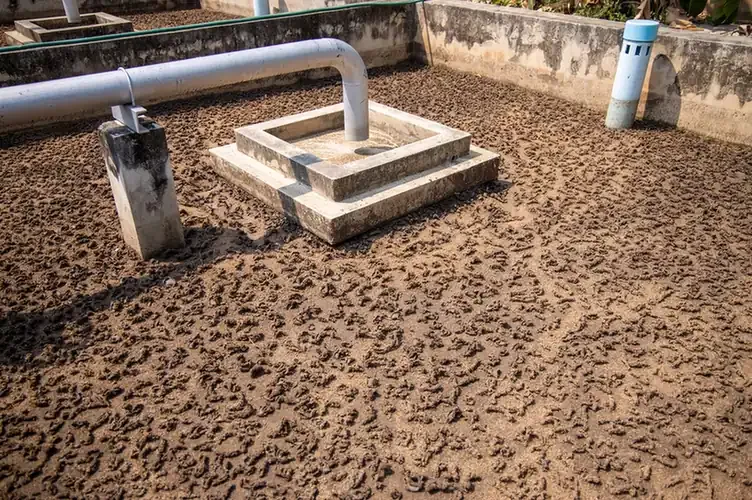
The concentrated solid material is commonly called sludge cake. Depending on its moisture content, it may resemble a soft paste, damp soil or a material that holds its shape.
Cake still requires suitable containment, handling and an appropriate destination. Dewatering does not automatically make contaminated or hazardous sludge non-hazardous. Where composition is uncertain, sludge sampling can help establish the information needed to assess the material.
The distinction between liquid sludge and dewatered cake also appears in the government’s sewage sludge code of practice. That guidance concerns agricultural use in England, Wales and Northern Ireland; it does not mean that industrial sludge cake is automatically suitable for land application.
Filtrate or separated liquid
The water separated during dewatering is often called filtrate, although the terminology varies with the separation method.
Filtrate is not necessarily clean water. It can retain fine suspended solids, dissolved substances and other contaminants originating from the sludge. Its appearance alone cannot establish whether it is suitable for discharge.
The receiving destination therefore matters. Liquid might require further treatment, authorised discharge arrangements or separate collection. In England, the Environment Agency’s discharge guidance distinguishes discharges to the environment from trade effluent arrangements involving public foul sewers.
When does removing water before transport make sense?
Dewatering is worth assessing when sludge contains a high proportion of removable water and significant quantities are regularly transported. The potential benefit is particularly relevant where a site produces sludge continuously or has limited storage capacity.
However, reducing the quantity of cake transported is only one part of the assessment. Practical considerations include:
- How much dry solid material is present in the original sludge.
- Whether the sludge separates readily or requires conditioning.
- How much filtrate will be produced and where it can go.
- Whether suitable space and containment are available.
- Whether the receiving facility can accept the resulting cake.
- Whether the combined treatment and handling requirements are preferable to transporting untreated sludge.
For occasional small volumes, direct collection may be more practical than arranging separation on site. For larger or recurring quantities, the reduction in wet material sent for disposal may justify closer examination.
The purpose of sludge dewatering is to separate water from solids. Its transport benefit depends on the whole material balance, including the wet mass and volume of retained cake, and whether the separated liquid also needs off-site collection.
The most useful comparison is therefore not simply how many tonnes of cake remain. It is how much sludge originally required transport, how much liquid can be managed appropriately at the site, and how much residual material must still leave.