
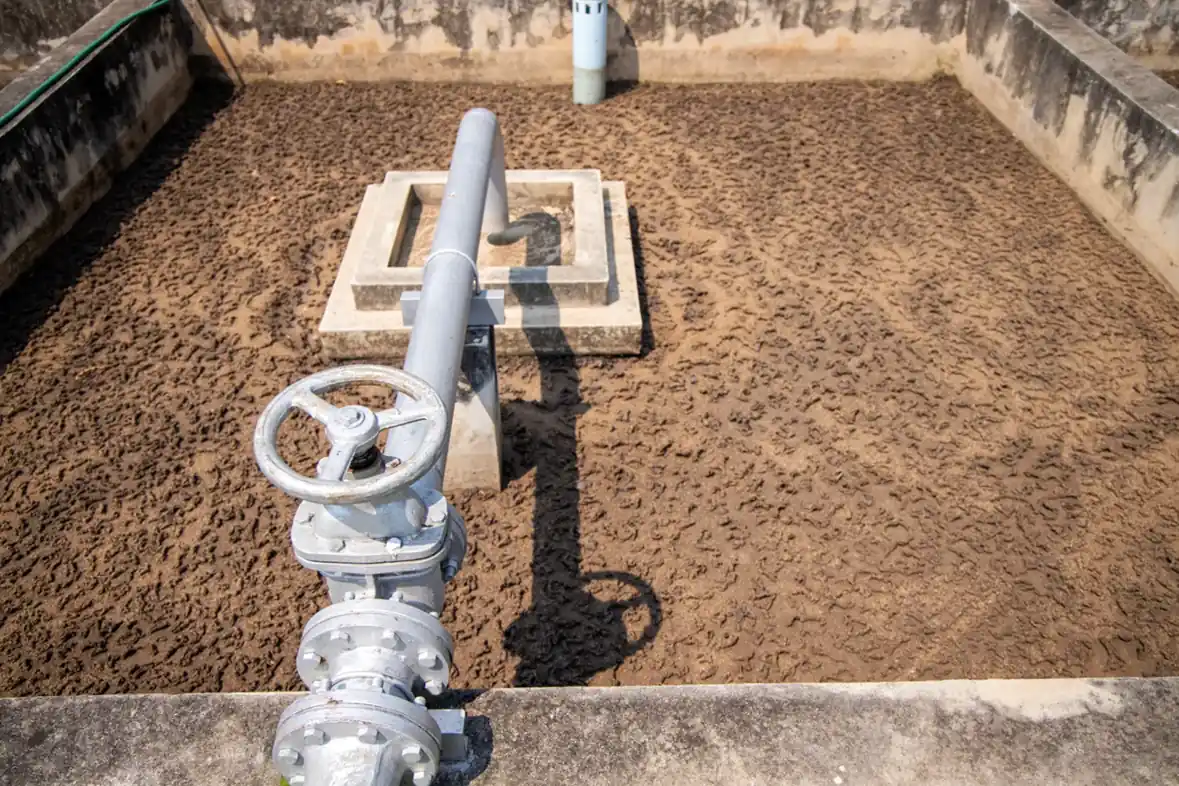
Industrial sludge removal
Types of Sludge
Sludge is the settled or separated solids that accumulate in tanks, lagoons, interceptors and treatment processes. What it is made of, how wet it is and where it came from all shape how it can be removed, treated and recovered or disposed of.
What is sludge
Sludge is the semi-solid material left when solids settle out of a liquid or are separated by a treatment process. It can be mostly water, mostly mineral grit, a biological mass, an oily emulsion or a chemical precipitate, and those differences matter more than the single word suggests.
This page is about physical and process sludges from drainage, industry and water treatment. It does not cover medical or clinical meanings of the term.
Consistency bands and why they matter
Consistency is often the first practical question because it decides how material can be moved from where it sits to where it can be treated or disposed of.
- Liquid: flows or can be pumped without priming. Suits vacuum tankers and liquid waste routes.
- Pumpable: moves with the right pump and hose but may need dilution, maceration or a progressive cavity pump.
- Cake: holds its shape and does not flow. It is commonly produced by dewatering and usually needs mechanical loading or handling for removal.
- Solid: spadeable or stackable. Needs excavation or mechanical handling and often a different disposal route.
A tank can hold more than one band at once. A lagoon may have liquid on top, a pumpable middle layer and a compacted base. The removal method has to suit the layer being worked, not just the average.
Common sludge types
The table below sets out typical sources, likely EWC codes and the usual handling route. Codes are candidates only. A name alone does not confirm a hazardous or non-hazardous classification, and the actual code depends on the process, contaminants and the assessment made for that waste.
| Sludge type | Typical source | Candidate EWC codes | Usual handling route |
|---|---|---|---|
| Sewage sludge | Settlement tanks, septic systems, package plants | 19 08 05, 20 03 04 | Tanker removal, dewatering, recovery to land or energy |
| Septic tank sludge | Domestic and small commercial septic systems | 20 03 04 | Vacuum tanker, treatment works reception |
| Oily sludge | Interceptors, oil-water separators, bunds | 13 05 02 | Specialist tanker, treatment, recovery or disposal as appropriate |
| Interceptor sludge | Forecourt and car park separators | 13 05 02, 13 05 03 | Emptying, separation, licensed disposal |
| Paint sludge | Spray booths, paint detackification | 08 01 11, 08 01 12 | Dewatering, hazardous or non-hazardous disposal |
| Metal finishing sludge | Plating, anodising, effluent treatment | 11 01 05, 11 01 09 | Dewatering, metals recovery or hazardous disposal |
| Food and DAF sludge | Food processing, dissolved air flotation | 02 03 03, 19 08 09 | Dewatering, energy recovery, land spreading where permitted |
| Digestate | Anaerobic digestion, biogas plants | 19 06 04, 19 06 06 | Separation, storage, land or energy route |
| Dredgings | Ponds, lakes, canals, harbours | 17 05 05, 17 05 06 | Dredging, dewatering, testing before disposal |
| Construction silt | Site settlement, wheel wash, attenuation | 17 05 04, 17 05 06 | Tanker or excavation, dewatering, reuse or disposal |
| Bentonite | Tunnelling, piling, directional drilling | 17 05 04, 01 05 04 | Separation, dewatering, disposal or reuse |
| Water treatment sludge | Potable water works, clarifiers | 19 09 02 | Dewatering, recovery or disposal |
How the type affects removal
Two sludges with the same name can behave differently. Sewage sludge from a well-mixed activated plant is usually pumpable. The same material after years in a lagoon may be a compacted cake under a layer of water. An oily interceptor sludge may be thin enough to pump but still need a hazardous route because of the oil and fuel content.
Access is often the limiting factor. A tanker needs a safe hard standing and a hose run that can reach the material. A cake that has to be excavated needs room for plant and a way to contain the liquid that drains from it. We can help with planned removal from tanks, lagoons, interceptors and settlement areas, and with the dewatering step that often comes before transport.
Sampling and classification
Classification starts with understanding the process that produced the waste and the information already available about its composition. Where sampling is needed, it should be representative of the material being assessed. One sample from the top of a lagoon may not represent the base, so the sampling approach should reflect the material and the question being asked, whether that is disposal, recovery to land or treatment.
Waste classification follows technical guidance and looks at the process that produced the waste, the substances present and their concentrations. A waste code is not decided by the name of the sludge alone. See sludge waste classification and sludge EWC codes for more detail, and the sludge EWC code checker for candidate codes and possible contaminants.
Dewatering and volume
Most sludges are mostly water. Dewatering reduces the volume that has to be moved and can change the disposal route. A belt press, centrifuge, filter press or geotextile bag all work differently and suit different materials. Chemical conditioning may be needed before mechanical dewatering, and the resulting liquor still needs a route.
Dewatering does not make a waste non-hazardous. It changes the physical form and reduces volume, but the classification still depends on what is in the solids and the liquor. See sludge dewatering for the process options.
Disposal and recovery routes
Routes depend on the waste code, classification, contamination and the receiving site’s acceptance criteria. Some biological sludges can have land, treatment or recovery routes where the applicable controls allow them. Oily wastes from oil-water separators have hazardous List of Waste entries, while other sludges need to be assessed against the process and substances present. Dredgings and construction silt may have reuse or recovery options where testing, classification and the applicable waste controls support that route.
Waste transfer documentation supports traceability. It does not by itself prove that a waste is legally compliant or correctly classified. See sludge disposal and liquid waste disposal for the routes and the questions to ask.
Where to go next
If you know the source and roughly how wet the material is, you can narrow the likely route quickly. If you do not, sampling and a look at the process that produced the sludge will usually settle it. Related pages cover sewage sludge removal, oil sludge removal, industrial sludge disposal and sludge removal cost.
Free online tool
Sludge EWC Code Checker
Look up sludge sources, possible contaminants and waste-code candidates.
Common questions
Frequently asked questions
Is all sludge hazardous?
No. Sludge is not hazardous simply because it is sludge. The correct List of Waste entry and, where required, the hazardous-property assessment depend on the process and substances present. Some entries are hazardous or non-hazardous by definition, while mirror entries require assessment. Sampling may be needed where the composition is not adequately known.
Does dewatering make sludge non-hazardous?
No. Dewatering removes water and reduces volume, but it does not change what is in the solids or the separated liquor. Classification still depends on the contaminants present and the assessment made for that waste.
Can I use the EWC code from a similar site?
It can be a starting point, but it is not a substitute for classifying your own waste. The same process at two sites can produce different codes if the inputs, contaminants or treatment differ. Use candidate codes to frame the question, then confirm with sampling and assessment.
Why does consistency matter for removal?
It affects how the material can be moved. Liquid and pumpable sludge may suit tankers and pumps. Cake or solid material may need mechanical handling or excavation, and wetter sludge may be dewatered before transport. That changes the equipment, access and disposal or recovery options.
Request a quote
Complete the form and we will get back to you.